
16th Century German Landsknecht/Kampfrau

Undoubtedly, German women of the 16th century had an individualist way of dressing compared to her English or French counterparts. For the most part, there were no corsets or support skirts (farthingales), no outrageous headwear except maybe that Steuchlein (German Bugle Hat), and the bright, sexy colors by the standards of their time would have English women dying of shock. Sumptuary laws which kept the English from wearing clothing above their station did not apply to the Landsknecht (mercenary soldiers or their wives). In fact, Emperor Maximilian was quoted as saying that the lives of the Landsknechts were so miserable and short that they deserved to wear flashy stuff.
For this event we will be creating a 16th-century Landsknecht/kampfrau wife. There are several layers for a typical outfit but because of time constraints and a small team we will not be making the underdress or a goller. We will be making a smock and apron with pleatwork and embroidery, the overdress, belt and pouch, as well as the German Bugle hat and veil. You will find a brief description of each item and some details on how we will be executing
Schurz/Apron is made out of a rectangular piece of linen, with pleatwork embroidery (smocking) at the top, using the same pattern as seen on the chemise. Early recreations of a split Trossfrau dress (separate jacket and skirt) were probably a misinterpretation that the apron was a part of the chemise visible in the waistline. You can find three different kinds of aprons: as a skirt, as a rectangular piece in the front, or as one with two rectangular pieces sewn together in the sides and pleated in the top and with bands over the shoulder. Most aprons in the 16th century German inventories indicate that yellow, red, black, and green aprons also existed. Only two pleatwork styles have survived in extant garments: honeycomb (Alpirsback monastery find) and pattern darning (Mary of Hapsburg chemise). Our apron will be made of linen and have honeycomb embroidery on it.

Pouch is made out of leather and has several compartments. Extant purses remaining from the early 16th century in Germany for working-class women. Purses were used by the working class, not created and put aside for safe-keeping, and thus most did not survive. We do have a lot of pictorial evidence in the four-volume set of Single-Leaf German Woodcuts. While it is known that some pouches were made of fabric, we have chosen to make both the belt and pouch from leather.
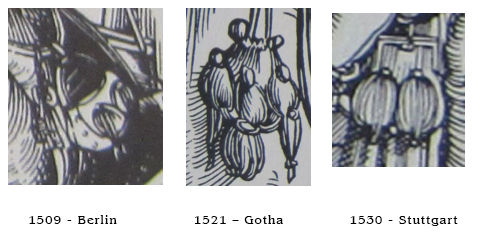
The hemd, chemise, or smock is made out of linen unless you are wealthy, with pleatwork embroidery or smocking. The chemise can be either low cut or have a high neck collar and comes was either mid-thigh or mid-calf but rarely to the ankles. The chemise is made out of rectangular shapes gathered by the smocking around the neckline and cuffs. The pattern for the chemise is based on the Sture Shirt findings from Sweden and the fragments from the Alpirsbach monastery in Germany. The chemise is basically unisex, except for the few examples that have more smocking on the sleeves. The shirt is almost always white with colored banding, braid, or embroidery. Our shirt is based on the Sture Shirt with basic pleatwork and embroidery made in a lightweight linen. I found it interesting that they placed a guard over the pleating at the neck and wrists to give it further support but I also suspect to protect the pleats and for the pleats not to be an irritant to the wearer.

Various forms of hemds/chemise with pleatwork

The Sture Shirt
The Kleid/dress is a fitted bodice with a contrasting colored trim, which hides the stitches from the closing (either laced or hooks and eyes). It has long sleeves, often has and some woodcuts indicate that the sleeves are attached to the dress by ties. The skirt is made out of a gathered tube, either with rolled pleats or double box pleats, and has often two stripes in a contrasting color (some woodcuts indicate the use of brocade). While the outer dress was either made of felted wool or linen, our project will be done in a linen blend. The dress often had guards in the skirt, which could be a solid color, slashed, decorative fabric, or in our case patchwork. There are several pieces of art showing what appears to be quilt or pieced motifs. Since I love the concept of adding a stripe or guard that feels like a quilt block, we will be adding this feature to our skirt using the same pattern found in the image below. Guards were a decorative feature of the skirt and depended on you. The skirt is hoisted up by a belt worn over the hips, letting you use the opening in the front as a pouch, keeping you from tripping when you are on a march, or perhaps even to keep cool in the summer. When it comes to sleeves, the Trossfrau rarely had any complex double puff/slashed sleeves; their dresses are usually very simple without the decorations that the male garb had. The sleeves were most often simple, bell-shaped, or no sleeves at all. We have opted to have no sleeves based on the limitation of time to complete all of the layers of this ensemble. Of course, I could add decollete or strung-on sleeves at a later date.
The basic properties of the Landsknect dress are seen in many pieces of art and in and around 1530, the woodcuts, “The German single-leaf woodcut, 1500-1550” by Max Geisberg and in the Triumph of Maximillian.
, we will follow
The Identifying details:
Closed front opening possibly laced or hook/eye. (We are using hooks and eyes)
Predominantly square neckline both front and back (though there are examples of round front/back necks)
Guarding follows the neckline and along the edge of the opening down to the waist. The skirt may also have one or more guards on it.
Guarding can be slashed or patterned, or decorative. One row of our guarding will be piecework based on the design in the image below.
Skirt is pleated into the bodice.
Most sleeves are fairly simple. They could also have wide cuffed ‘funnel’ sleeves or no sleeves. We have opted for no sleeves based on time limitations.
Headgear is usually a wulsthaube and/or a beret (with and without feathers) of some kind. We are making a basic wulsthaube.
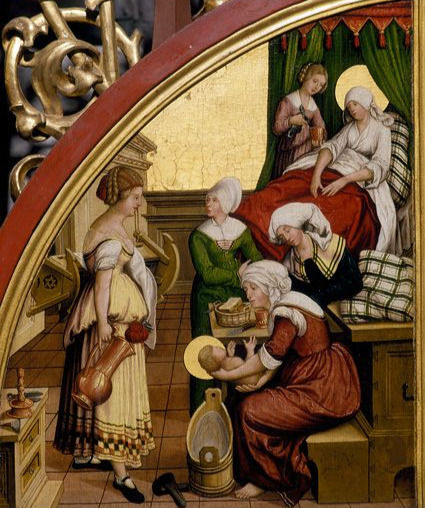

The idea of adding a patterned guard in our skirt is based on this painting by Geburt Mariens 1515-1525 dieses Blid (on left). Except for the colors we will be following the grid pattern in the guard. The image on the right is from the works of Freydal (1512-1516) and was my inspiration to see if there was more evidence that this kind of art in clothing existed after I saw the recreation of this one done by Amie Sparrow.


Portrait of a Woman 1522 Mrs. Seldompeace 1535
by Aldorf Albrecht by Erlangen
Good examples of guards on the bodice. Note that these guards cover the whole shoulder while others are narrow, like the image above by Gerburt.
Wulsthaube/Steuchlein (German Bugle Hat and Veil) while I don’t personally like to wear headwear it was always worn in 16th century Germany. No one in this period was without something on their head unless they were bathing. Outside of the beret or straw hat most married women wore a Steuchlein also known as the Bugle Hat. The veil worn over the Wulst coul be tied in many different fashions and did not have to be white or a solid color as is evident in the image below. This headwear had several layers to it, of which we plan on making all of them. Those pieces are:
Uminderlein – line strip at hairline
Unterhauben – linen undercap
Wulst – round or ovoid bulge
Schleier – veil

References:
The German Renaissance of Genoveva - http://germanrenaissance.net/tag/pleatwork/
16th Century German Costuming, Amie Sparrow - https://amiesparrow.wordpress.com/
Wiiljascorner. An Overview of the Trossfrau. 4 Jun. https://whiljascorner.wordpress.com/2013/06/04/an-overview-of-the-trossfrau/
http://www.wga.hu -Web Gallery of Art, The Web Gallery of Art is a virtual museum and searchable database of Western (European) fine arts of the Medieval, Renaissance etc
Cathrin Åhlén – 16th Century German – wulsthaub. https://katafalk.wordpress.com/2013/01/01/patternmaking-for-the-kampfrau-wulsthaube/
Gerrad, Chantelle. Historical Costuming- The ‘Kampfrau’ or Trossfrau’ Dress …under construction. https://historical.chantellegerrard.com/the-kampfrau-or-trossfrau-dress-under-construction/
A Final Word
This documentation was created for Revenge of the Stitch with my team, the Mischief Makers, in April 2022. Revenge of the Stitch is a twenty-four-hour competition where a team of up to six people creates an entire outfit in 24 hours. I had a team of three, and we did fabulous work in that time period. Check out these pictures from the event what we produced in 24 hours.

Comments