
Mullah Nasreddin and the Feast

A Tale of the Middle East as told by Scholastica Joycors
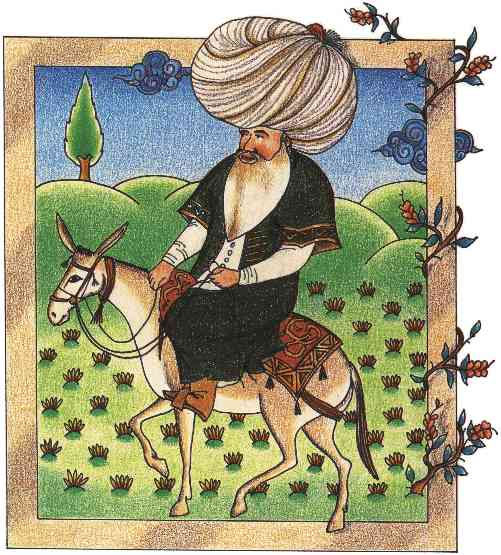
MULLAH NASREDDIN was sometimes a wise man and sometimes a fool. I will leave it up to you which he is in this story, but he is always watchful and kind. You see, it happened to be on a fine fall day when he was traveling home from a trip that he heard there was to be a great feast in town and that all were invited to attend, and since Nasreddin loved food, it is something he was not going to miss. As he passed through the town gates, he observed two children chasing after a drove of goats, trying to get them into the pen without any luck. In fact, it was going very badly, for they were knocking over laundry and eating vegetables out of baskets; they were creating quite a scene.
Nasreddin sat on his faithful donkey for a moment trying to figure out how he could help when he had a brilliant idea. He slowly climbed off his donkey and had the children bring him a basket. He then produced a round of bread which he broke into small pieces and put in the basket. Then he handed each child a handful of bread pieces and told them to quietly offer them to the goats to coax them home. He then began making a path of bread back to the pen where he placed the rest of the bread in a pile. The bread path worked like a charm, and before you knew it, all of the goats were back in the pen, but one who before going in knocked poor Nasreddin over and took the last piece of bread he had from his hand. The children helped Nasreddin up and thanked him for his help.
It was now late. Nasreddin had dust all over his clothes, but he wanted to get to the feast sooner than later, so he dusted himself off and approached the feast hall. Standing at the door of the feast hall was a rather large guard who looked at Nasreddin with disdain, for he did not look or smell good. The visiting prince had proclaimed that all were welcomed to the feast regardless of their station in life. Nasreddin was led into the banquet hall and sat at a table in the back of the room where few would see or smell him. The smell of the food wafting through the room was delightful, and he could hardly wait for the plate of food to make it to him… but when it got there, only crumbs were left. After this happened a couple of times, he decided to go home but not before noticing that all the best food was going to the well-dressed people in the room and the prince was at the head table.
Nasreddin left quickly, went home, had a scented bath drawn for himself, and requested his best clothes be brought to him straight away. When his bath was over, he put on his best coat and turban and went straight back to the feast hall. Nasreddin strutted up to the guard who thought he was someone important and bowed to him. He then escorted his elegantly dressed guest to the head table, where he sat him close to the visiting prince.
Before long, servants brought large platters of spiced meats, seasoned vegetables, breads, fruits, nuts, sweetmeats, and other delicacies were put before him, and a large glass of wine was poured for him. Before Nasreddin began to fill his plate with food, he looked out over the hall and saw people from all walks of life and varying stations of importance. Some people he recognized and some he did not, but nobody knew who he was in his fancy clothes, and many people smiled and waved at him as if he was someone of great importance.
Nasreddin spent a few minutes talking politely with the prince about trivial things and then began putting food on his plate. While this was the normal thing to do, what he did next was completely unexpected. He grabbed a piece of eggplant and smeared it on his beautiful coat, then he took a handful of spiced lamb and put it into the cuff of his coat. He put nuts and dates into the pockets of his trousers. He took a string of sausages and wrapped them around his neck like a scarf. Everyone in the room stopped and stared in amazement as Nasreddin continued to feed his coat. They didn’t know what to say or think. Finally, Nasreddin took his glass of wine and poured it into one of the folds of his turban. At this point, the prince could no longer be silent and said, “My elegant friend, why are you putting this fine food all over your beautiful clothes?” Nasreddin stopped feeding his coat, rose, bowing slightly to the prince in respect, and said, “When I first arrived, I was dusty and smelly. When the platters of food came by, they were empty, and I went hungry. So, I went home and dressed in my very best clothes, which got me treated like royalty. I figured since it was the coat that had gotten me such a prime seat at the table, perhaps I should feed it first.”
With that, the prince laughed and laughed and realized that if you are going to invite the whole town to feast with you, perhaps you should feed them all the same regardless of their appearance…and in the future, that is exactly what he did.
Many people claim Nasreddin as their own, i.e., Turks, Afghans, Iranians, even China, and Italy, to mention a few. Nasreddin’s stories are best known throughout the Middle East and are usually told as a joke followed by a moral. We have been sharing these stories since the early 12th century.
©2021 from Crazy About Christmas by MyLinda Butterworth used with permission. Permission granted this to tell this version with attribution.
Appeared in THE YEOMAN - November 2021


Comments