
A Wise or Cunning Cat

Lady Scholastica Joycors
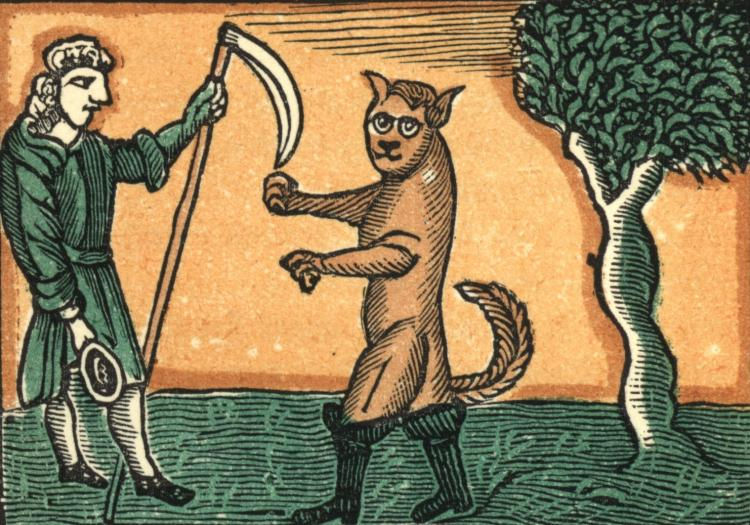
Many of us see a cat as a companion or an animal to catch the mice or other small vermin, but for centuries cats, among other animals, have been tricksters. Puss In Boots the title most of us know is the most famous of the animal helper tales. Charles Perrault published The Master Cat; or Puss in Boots in his Histires ou Conteos du temps passe in 1697, but the story of the trickster cat preceded Perrault's tale by a few centuries. A variant of the story, Constantino Fortunato, appears in Straparola's Piacevole notti (Night 2, Fable 1) in the sixteenth century (ca. 1550-3). Most scholars think that Straparola derived his story from oral folklore, but no evidence is available to substantiate the theory beyond the general popularity and worldwide spread of the tale. Giambattista Basile also included a trickster cat story--Gagliuso (Day 2, Tale 4)--in Il Pentamerone in the seventeenth century (ca. 1634-6). An alternate translation of Gagliuso is Caglioso and is the favored version by current scholars.
This story has been found in all parts of Europe, across Siberia, onward to India, Indonesia, and the Philippines. It also traveled with colonists and travelers from Europe to Africa and the American Indians. The further away from central Europe, the stories take on more variations from the well-known literary version. The greatest problem is distinguishing variations of the tale from other animal helper stories. It is hard to determine which stories are part of the Puss In Boots tradition and which are independent creations (Thompson 1946).
Interesting fact is that the boots we all know did not appear in this story until Perrault added them in his version called The Master Cat. Some scholars believe the boots are not Perrault's invention but came from the French oral sources he had heard. Either way, Perrault's version gained such popularity that it later influenced other oral and literary versions with additions of the boots and the ogre we meet later in the story. In the end, the boots give Puss a sign of distinction and a level of respect. Jack Zipes reminds us that even during the time of this tale that clothes make the person (Zipes 2001).
Cats are one of the most popular species of domestic pets in the world. The tale's popularity might rest simply on its narrative of a cat's cunning, one of its most endearing traits to cat owners around the world. It is well known that a cat has a certain skill level in trickery and you will note how that is used in the tale by how they hunt, play dead, and other subtle ways of deceit or cunning.
Another note worth bit of trivia is the giving a gift. Gift giving has long been a method of gaining favor, such as with a king. Gifts are often presented to sovereigns, dignitaries, and diplomats in hopes of gaining their favor while showing honor to them. Gift giving can also be used to show one's wealth through the costliness of the gift.
According to Maria Tatar, "Perrault's Puss in Boots is seen as a creature of his time, a cat who models the kind of behavior required to succeed in grand society under Louis XIV in seventeenth-century France" (Tatar 2002).
I could go on with more tidbits about the tale, but I believe that this story just as others that in the telling we learn more about the time period it evolved from and their environment just by the telling for we all know that stories travel from mouth to ear and from country to country. So now enjoy the first recorded iteration of this tale from Italy.
Costantino Fortunato
The Facetious Nights of Straparola by Giovanni Straparola (1550)
Soriana dies and leaves three sons, Dusolino, Tesifone, and Costantino. The last-named, by the aid of his cat, gains the lordship of a powerful kingdom.
IT is no rare event, beloved ladies, to see a rich man brought to extreme poverty, or to find one who from absolute penury has mounted to high estate. And this last-named fortune befell a poor wight of whom I have heard tell, who from being little better than a beggar attained the full dignity of a king.
There was once upon a time in Bohemia a woman, Soriana by name, who lived in great poverty with her three sons, of whom one was called Dusolino, and another Tesifone, and the third Costantino Fortunato. Soriana had nought of any value in the way of household goods save three things, and these were a kneading trough of the kind women use in the making of bread, a board such as is used in the preparation of pastry, and a cat. Soriana, being now borne down with a very heavy burden of years, saw that death was approaching her, and on this account made her last testament, leaving to Dusolino, her eldest son, the kneading trough, to Tesifone the paste board, and to Costantino the cat. When the mother was dead and duly buried, the neighbours round about would borrow now the kneading trough and now the paste board, as they might happen to want them, and as they knew that the young men were very poor, they gave them by way of repayment a cake, which Dusolino and Tesifone ate by them selves, giving nothing of it to Costantino, the youngest brother.
And if Costantino chanced to ask them to give him aught they would make answer by
bidding him to go to his cat, who would without fail let him have what he wanted, and on this account poor Costantino and his cat underwent much suffering. Now it chanced that this cat of Costantino's was a fairy in disguise, and the cat, feeling much compassion for him and anger at his two brothers on account of their cruel treatment of him, one day said to him, 'Costantino, do not be cast down, for I will provide for your well-being and sustenance, and for my own as well.' Whereupon the cat sallied forth from the house and went into the fields, where it lay down and feigned to be asleep so cleverly that an unsuspecting leveret came close up to where it was lying, and was forthwith seized and killed.
Then, carrying the leveret, the cat went to the king's palace, and having met some of the courtiers who were standing about it, said that it wanted to speak to the king. When the king heard that a cat had begged an audience with him, he bade them bring it into his presence, and, having asked it what its business was, the cat replied that Costantino, its master, had sent a leveret as a present to the king, and begged his gracious acceptance of the same. And with these words it presented the leveret to the king, who was pleased to accept it, asking at the same time who this Costantino might be. The cat replied that he was a young man who for virtue and good looks had no superior, and the king, on hearing this report, gave the cat a kindly welcome, and ordered them to set before it meat and drink of the best. The cat, when it had eaten and drunk enough, dexterously filled the bag in which it had brought the leveret with all sorts of good provender no one was looking that way, and having taken leave of the king, carried the spoil back to Costantino.
The two brothers, when they saw Costantino making good cheer over the victuals, asked him to let them have a share, but he paid them back in their own coin, and refused to give them a morsel, wherefore on this account the brothers hereafter were tormented with gnawing envy of Costantino's good for tune. Now Costantino, though he was a good-looking youth, had suffered so much privation and distress that his face was rough and covered with blotches, which caused him much discomfort; so the cat having taken him one day down to the river, washed him and licked him carefully with its tongue from head to foot, and tended him so well that in a few days he was quite freed from his ailment. The cat still went on carrying presents to the royal palace in the fashion already described, and by these means got a living for Costantino.
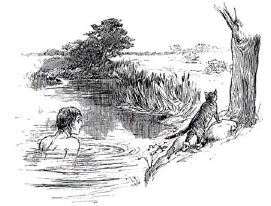
But after a time the cat began to find these journeyings to and from the palace somewhat irksome, and it feared more over that the king's courtiers might be come impatient thereanent; so it said to Costantino, 'My master, if you will only do what I shall tell you, in a short time you will find yourself a rich man.' 'And how will you manage this?' said Costantino. Then the cat answered, 'Come with me, and do not trouble yourself about anything, for I have a plan for making a rich man of you which cannot fail.' Whereupon the Cat and Costantino betook themselves to a spot on the bank of the river which was hard by the king's palace, and forthwith the cat bade its master to strip off all his clothes and to throw himself into the river. Then it began to cry and shout in a loud voice, 'Help, help, run, run, for Messer Costantino is drowning!' It happened that the king heard what the cat was crying out, and bearing in mind what great benefits he had received from Costantino, he immediately sent some of his house hold to the rescue. When Costantino had been dragged out of the water and dressed by the attendants in seemly garments, he was led into the presence of the king, who gave him a hearty welcome, and inquired of him how it was that he found himself in the water; but Costantino, on account of his agitation, knew not what reply to make; so the cat, who always kept at his elbow, answered in his stead, 'You must know, O king! that some robbers, who had learned by the agency of a spy that my master was taking a great store of jewels to offer them to you as a present, laid wait for him and robbed him of his treasure, and then, wishing to murder him, they threw him into the river, but by the aid of these gentlemen he has escaped death.' The king, when he heard this, gave orders that Costantino should enjoy the best of treatment, and seeing that he was well made and handsome, and believing him to be very rich, he made up his mind to give him his daughter Elisetta to wife, and to endow her with a rich dowry of gold and jewels and sumptuous raiment.
When the nuptial ceremonies were completed and the festivities at an end, the king bade them load ten mules with gold and five with the richest garments, and sent the bride, accompanied by a great concourse of people, to her husband's house. Costantino, when he saw himself so highly honoured and loaded with riches, was in sore perplexity as to where he should carry his bride, and took counsel with the cat thereanent. Said the cat: 'Be not troubled over this business, my master; we will provide for everything.' So as they were all 'riding on merrily together the cat left the others and rode on rapidly in advance, and after it had left the company a long way behind, it came upon certain cavaliers whom it thus addressed: 'Alas! you poor fellows, what are you doing there? Get hence as quickly as you can, for a great body of armed men is coming along this road and will surely attack and despoil you. See, they are now quite near; listen to the noise of the neighing horses.' Whereupon the horsemen, overcome with fear, said to the cat: 'What then shall we do?' and the cat made answer: 'It will be best for you to act in this wise. If they should question you as to whose men you are, you must answer boldly that you serve Messer Costantino, and then no one will molest you.' Then the cat left them, and, having ridden on still farther, came upon great flocks of sheep and herds of cattle, and it told the same story and gave the same counsel to the shepherds and drovers who had charge of these. Then going on still farther it spake in the same terms to whomsoever it chanced to meet.
As the cavalcade of the princess passed on, the gentlemen who were accompanying her asked of the horsemen whom they met the name of their lord, and of the herdsmen who might be the owner of all these sheep and oxen, and the answer given by all was that they served Messer Costantino. Then the gentle men of the escort said to the bridegroom: 'So, Messer Costantino, it appears we are now entering your dominions?' and Costantino nodded his head in token of assent, and in like manner he made answer to all their interrogations, so that all the company on this account judged him to be enormously rich. In the meantime the cat had ridden on and had come to a fair and stately castle, which was guarded by a very weak garrison, and these defenders the cat addressed in the following words: 'My good men, what is it you do? Surely you must be aware of the ruin which is about to overwhelm you.' 'What is the ruin you speak of?' demanded the guards. 'Why, before another hour shall have gone by,' replied the cat, 'your place will be beleaguered by a great company of soldiers, who will cut you in pieces. Do you not already hear the neighing of the horses and see the dust in the air? Wherefore, unless you are minded to perish, take heed to my advice, which will bring you safely out of all danger. For if anyone shall demand of you whose this castle is, say that it belongs to Messer Costantino Fortunato.' And when the time came the guards gave answer as the cat had directed; for when the noble escort of the bride had arrived at the stately castle, and certain gentlemen had inquired of the guards the name of the lord of the castle, they were answered that it was Messer Costantino Fortunato; and when the whole company had entered the castle they were honourably lodged therein.
Now the lord of this castle was a certain Signor Valentino, a very brave soldier, who only a few days ago had left his castle to bring back thereto the wife he had recently espoused, but as ill- fortune would have it, there happened to him on the road, somewhile before he came to the place where his beloved wife was abiding, an unhappy and un foreseen accident by which he straightway met his death. So Costantino Fortunato retained the lordship of Valentino's castle. Not long after this Morando, King of Bohemia, died, and the people by acclamation chose Costantino Fortunato for their king, seeing that he had espoused Elisetta, the late king's daughter, to whom by right the succession to the kingdom belonged. And by these means Costantino rose from an estate of poverty or even beggary to be a powerful king, and lived long with Elisetta his wife, leaving children by her to be the heirs of his kingdom.
Bibliography
Straparola, Giovanni Francesco. The Facetious Nights by Straparola. W. G. Waters, translator. Jules Garnier and E. R. Hughes, illustrators. London: Privately Printed for Members of the Society of Bibliophiles, 1901. 4 volumes.
Tatar, Maria M. The Annotated Classic Fairy Tales. New York: W. W. Norton, 2002
Thompson, Stith. The Folktale. New York: Holt, Rinehart, and Winston, 1946.
Similar Tales from Across Cultures
(note that these stories are collections from oral tradition and we don't actually
know how old they are, only that someone found them worthy of putting in print)
Bukhtan Bukhtanovich - from Russia - Afanasyev, Aleksandr. Russian Fairy Tales. Norbert Guterman, translator. New York: Pantheon Books, 1945.
Caglioso (see Gagliuso) from Italy - Basile, Giambattista. The Pentamerone, or The Story of Stories. John Edward Taylor, translator. London: David Bogue, 1850.
Costantino Fortunato - Straparola, Giovanni Francesco. The Facetious Nights by Straparola. W. G. Waters, translator. Jules Garnier and E. R. Hughes, illustrators. London: Privately Printed for Members of the Society of Bibliophiles, 1901. 4 volumes.
Count Piro also known as How the Beggar Boy Turned into Count Piro - from Greece - Gonzenbach, Laura. Beautiful Angiola: The Great Treasury of Sicilian Folk and Fairy Tales Collected by Laura Gonzenbach. Jack Zipes, translator and editor. New York: Routledge, 2004.
Dame Cat; or, The Wedding Patron - Bodker, Laurits; Hole, Christina; and D'Aronoco, G., eds. European Folk Tales. European Folklore Series, vol. 1. Copenhagen: Rosenkilde and Bagger, 1963.
Don Joseph Pear - from Italy - Crane, Thomas Frederick. Italian Popular Tales. Boston: Houghton Mifflin Company, 1885
The Earl of Cattenborough - Jacobs, Joseph, ed. European Folk and Fairy Tales. New York: G. P Putnam's Sons, 1916.
The Gazelle - from Africa - Lang, Andrew, ed. The Violet Fairy Book. New York: Dover, 1966. (Original published 1901.)
The Gilded Fox - from France - Delarue, Paul, ed. The Borzoi Book of French Folk Tales. Austin E. Fife, translator. New York: Alfred E. Knopf, 1956.
Giovanuzza the Fox - from Italy - Calvino, Italo. Italian Folktales. George Martin, translator. New York: Pantheon Books, 1980.
Lord Peter - from Norway - Asbjornsen, Peter Christen and Moe, Jorgen. East o' the Sun and West o' the Moon. George Webbe Dasent, translator. Popular Tales from the Norse. Edinburgh: David Douglass, 1888..
Mighty Mikko - Clarkson, Atelia, and Cross, Gilbert, B., eds. World Folktales: A Scribner Resource Collection. New York: Charles Scribner's Sons, 1980.
The Miller and the Fox - from Armenia - Villa, Susie Hoogasian. 100 Armenian Tales. Detroit: Wayne State University Press, 1966.
The Poor Miller's Apprentice and the Cat - from Germany - Grimm, Jacob and Wilhelm. Household Tales. Margaret Hunt, translator. London: George Bell, 1884.
©2019 MyLinda Butterworth (scholastica.ppa@gmail.com) This article first appeared in The Yeoman - November 2019
Permission is granted for republication in SCA-related publications, provided the author is credited and receives a copy.


Comments